
Our approach
Ownership, not intervention
Three objectives, six work-scope pillars and a delivery model where communities and youth lead the work themselves.
Program objectives
What we set out to achieve
Cover bare land with trees
Provide shade, encourage precipitation and protect water bodies through targeted planting.
Grow fruit for nutrition
Empower households to grow fruit trees for improved nutrition and surplus income.
Offer alternative fuels
Introduce maize-kernel charcoal (Mimpukutu) to cut reliance on charcoal from trees.
Work scope
Six pillars, delivered every season
Each pillar runs continuously and reinforces the others — awareness creates clubs, clubs plant trees, training sustains them, follow-up keeps them alive.
Awareness Creation
Sensitising school children and communities on the causes and effects of climate change, and forming manageable clubs with their own training plans.
Key activities
- School talks and club visits
- TV and radio talk shows
- Public rallies and field visits
- Churches and community gatherings
- Posters and social media
Tree Planting
Household-level planting keeps monitoring simple and ownership local. Varieties range from fruit trees to hardwood species suited to each district.
Key activities
- Household planting plots
- Fruit and hardwood varieties
- Youth trainers as field guides
- Headmen supervision and record keeping
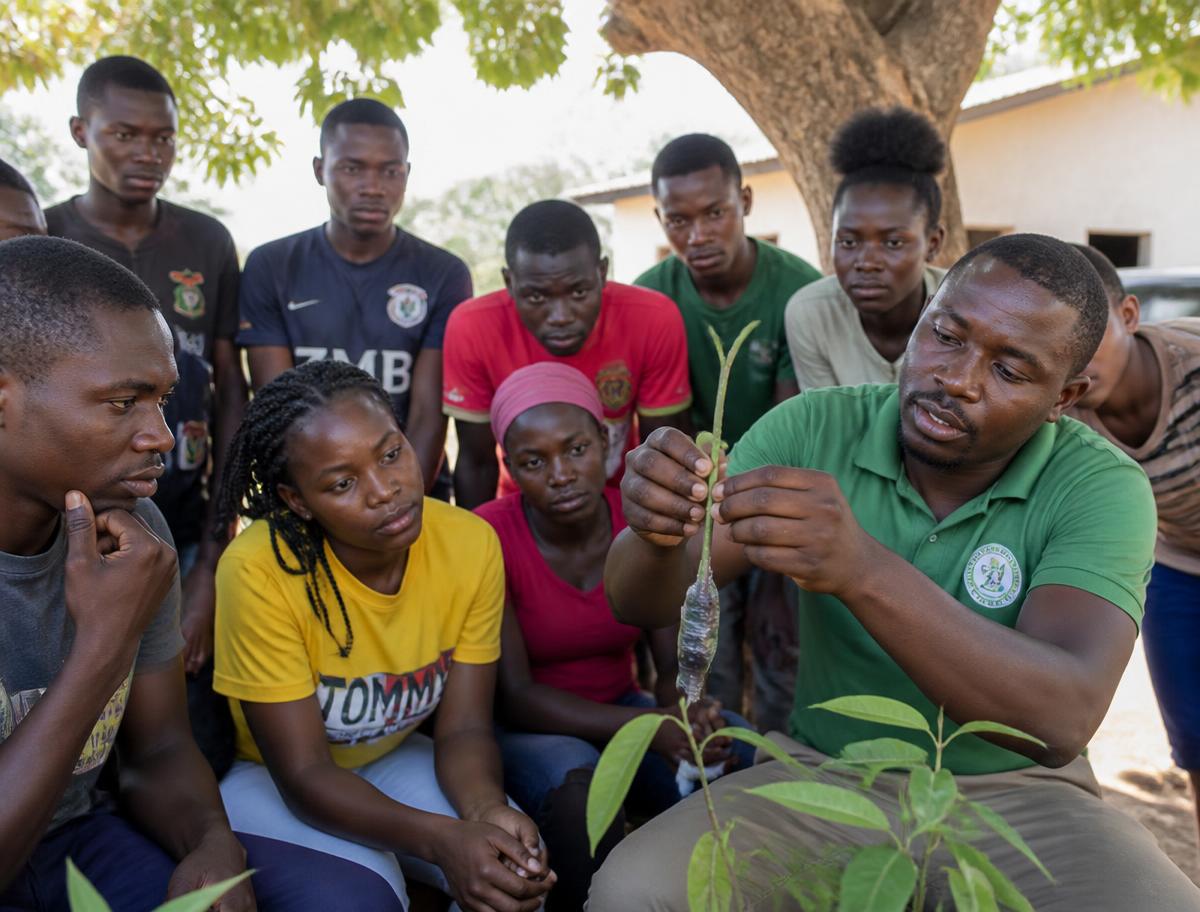
Training of Youth
Practical, participatory training that turns young people into the programme's permanent technical backbone.
Key activities
- Nursery management, budding and grafting
- Tree and soil types
- Pest control for fruit trees
- Water body buffer protection
- Kernel storage and kernel-charcoal production
- Climate adaptation practices
Community Follow-Up
Continuous engagement visits provide guidance and motivation, and let groups learn from each other's results.
Key activities
- Scheduled guidance visits
- Demonstration plantation tours
- Best-practice sharing between groups
Information Sharing & Networking
Collaboration with like-minded institutions avoids duplication and puts community experience into policy conversations.
Key activities
- Partnerships with aligned institutions
- Conference and policy participation
- Print and online media sharing
Monitoring, Evaluation & Reporting
Documented and auditable reporting keeps management, the board, funders and government aligned on progress.
Key activities
- Regular documentation and reporting
- Records retained for audit
- Annual evaluation against targets
- Independent external consultant review
Beneficiaries
Who this programme serves
Households
Planting, fruit production and alternative fuel adoption at home.
Youth in communities
Trained as nursery managers, trainers and field monitors.
Learners in schools
Environmental clubs that carry knowledge across generations.
Justification
Why this model works
- Community and youth engagement drives both productivity and environmental protection.
- Sustainable use of natural resources — including kernel-charcoal alternatives — reduces pressure on forests.
- An ownership model, not an interventionist one, produces self-sustaining outcomes.
- Training builds long-term behaviour change that outlasts any single funding cycle.
- Partnerships with ministries, ZEMA, ZNFA and national media multiply reach.

Join the movement
Help us reach £900,000 on Global Giving
Every contribution plants trees, trains youth and builds climate resilience in Zambian communities. Your support funds a 5-year transformation towards a $1,000,000 program goal.
Make a Donation
Currency
Select amount
Frequency
Secure payment · All currencies accepted · Tax receipt available